

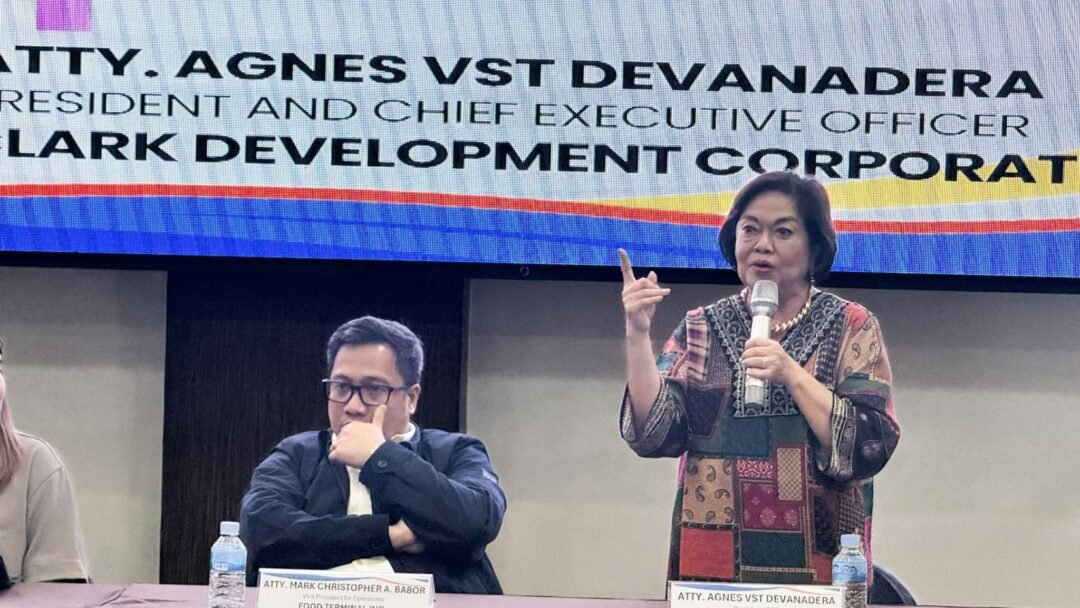
Photo: CDC
CLARK FREEPORT — Clark Development Corporation (CDC) on March 30 convened Clark locators and partner agencies for a briefing on fuel supply conditions and food security measures, including the implementation of the “Benteng Bigas sa Clark” program, aimed at supporting low‑income workers amid rising prices and supply constraints.
CDC President and CEO Atty. Agnes VST Devanadera said the meeting was called to provide locators with updated information on fuel availability, conservation measures, and government‑backed interventions to address the immediate needs of workers in the zone.
Atty. Devanadera said CDC had secured assurances on fuel supply support for Clark locators following discussions with industry stakeholders, noting that the corporation will circulate a questionnaire to determine fuel requirements under normal operations.
The data will be used to prioritize essential business needs and avoid hoarding that could worsen supply pressures.
She said the assessment will focus on core operational requirements, support services such as delivery and logistics, and other fuel use, as CDC works with partners to manage supply responsibly.
As part of medium‑term measures, the CDC chief said the state-run firm is encouraging locators to adopt renewable energy solutions, including rooftop solar installations, and is facilitating discussions with developers willing to finance such projects to avoid disruptions to companies’ working capital. CDC is also accelerating proposals for solar farm developments within the Freeport Zone to help ease power supply concerns.
However, she said the immediate challenge remains the rising cost of living faced by workers, particularly those at the lower levels of the workforce.
“This is why we called this briefing — to listen to our government partners and to work together on a sustainable program,” Atty. Devanadera said, referring to the rollout of the “Benteng Bigas” initiative.
Under the program, affordable rice priced at ₱20 per kilo will be made available primarily to minimum wage earners and low‑income workers such as security guards, gardeners, and other support staff. Atty. Devanadera appealed to companies and employees to prioritize those most in need and avoid competing for limited supply.
She said the program is being implemented in coordination with Food Terminal Inc. (FTI), the Department of Agriculture (DA), and the Kadiwa program, with arrangements being made to ensure orderly distribution and scheduling to maximize reach and efficiency.
FTI officials presented the operational guidelines and requirements for the rice allotment during the briefing, outlining procedures to ensure transparency, quality control, and sustainability of the initiative.
The event gathered representatives from various industries, including ICT, industrial, developer, service, tourism, commercial, logistics, aviation-related, institutional, and utility sectors.
The briefing was attended by representatives of Clark locator companies from the manufacturing, logistics, aviation, services, and estate management sectors, alongside members of the Clark Investors and Locators Association (CILA), led by its president Ernesto Gorospe. Government partners present included officials from Food Terminal Inc., the Department of Agriculture, and the Department of Labor and Employment (DOLE), which were tapped to support implementation, worker identification, and coordination at the company level.
CDC officials present included Vice President for Administration and Finance Jose Miguel de la Rosa and Assistant Vice President for Administration along with senior officers overseeing external affairs and corporate social responsibility programs.
Atty. Devanadera said CDC will also open shared facilities within the Freeport Zone, including designated market spaces, to allow participating vendors to sell goods at lower prices by removing rental and access costs. She encouraged locators to replicate similar initiatives within their companies where feasible.
The CDC chief said coordination and cooperation among locators, government agencies, and workers will be critical in navigating current challenges and maintaining stability within the Freeport Zone. (PR CDC)