

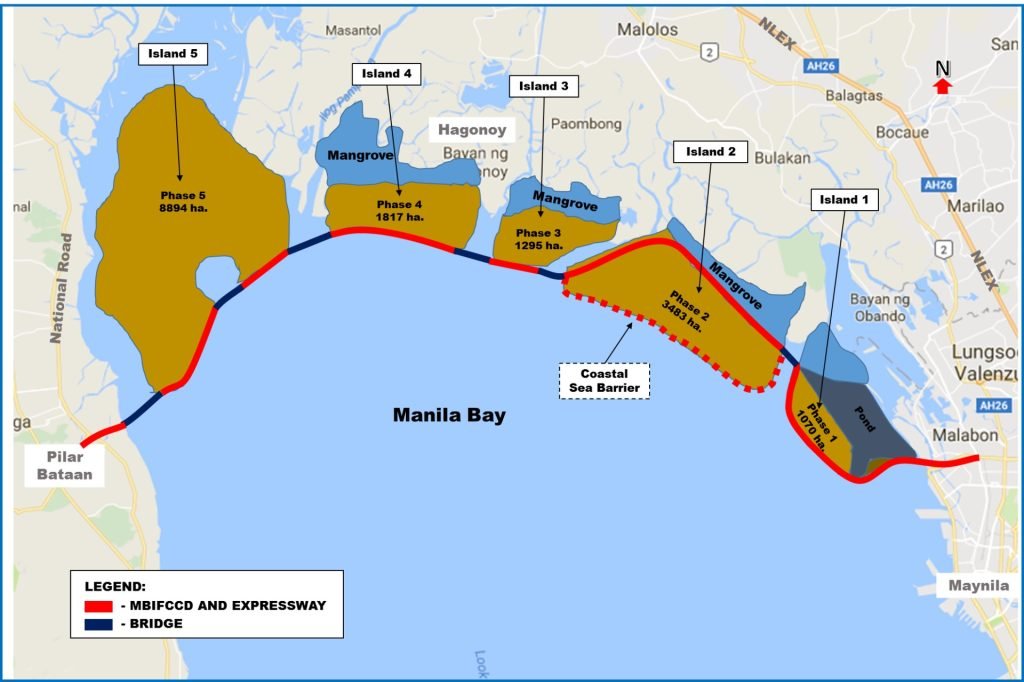
An initial rendering of the proposed alignment of the Manila Bay Integrated Flood Control, Coastal Defense and Expressway Project. The Department of Public Works and Highways (DPWH), in partnership with the Asian Development Bank (ADB), is advancing the landmark infrastructure project aimed at providing a long-term flood mitigation solution for Metro Manila and the provinces of Bulacan, Pampanga, and Bataan, while improving regional connectivity. (DPWH)
MALOLOS CITY, Bulacan — The long-envisioned Manila-Bulacan-Pampanga-Bataan Coastal Road-Dike Project has taken a significant step forward after the Asian Development Bank (ADB) joined the Department of Public Works and Highways (DPWH) in undertaking the project’s feasibility study, DPWH Secretary Vince Dizon announced.
Dizon revealed the development during a press briefing in Malolos City, where he led the filing of cases against former officials of the Bulacan 1st District Engineering Office and contractors accused of irregularities involving flood control projects in the province.
According to the DPWH chief, the ADB’s involvement in conducting the feasibility study is among the initial and most crucial stages of the project, as it will determine the alignment of the proposed coastal road-dike and help secure the funding necessary for its implementation.
Officially known as the Manila Bay Integrated Flood Control, Coastal Defense and Expressway Project, the initiative is designed to provide a long-term solution to recurring flooding in coastal communities while creating an alternative transportation corridor linking Metro Manila to the provinces of Bulacan, Pampanga, and Bataan.
The proposed infrastructure project has long been sought by residents and local leaders in the three provinces, particularly those living in low-lying coastal areas frequently affected by flooding caused by high tides and storm surges from Manila Bay.
Dizon said the project is expected to serve a dual purpose by strengthening flood control measures and improving regional connectivity, supporting economic growth and mobility in Central Luzon.
Construction of the massive undertaking is estimated to take at least five years once approved and funded.
Bulacan Governor Daniel Fernando welcomed the progress of the project, saying it offers a concrete and long-term solution to decades-old flooding problems experienced by residents of coastal municipalities such as Calumpit and Hagonoy.
Fernando cited the success of flood mitigation efforts in Obando, where the construction of a comprehensive dike system by the DPWH beginning in 2012 significantly reduced flooding incidents. The municipality reportedly remained flood-free for more than a decade after the project was completed.
The Manila-Bulacan-Pampanga-Bataan Coastal Road-Dike Project recently received endorsement from the Regional Development Council (RDC) of Central Luzon based on recommendations from the Department of Economy, Planning and Development.
The project was first jointly presented to President Ferdinand R. Marcos Jr. in 2023 by Governor Fernando, then Pampanga Governor Dennis Pineda, and Bataan Governor Jose Enrique Garcia III during an RDC meeting in Malolos City. It was again pushed during another RDC meeting in San Jose del Monte City in 2025 before eventually gaining formal approval.
Once realized, the project is expected to complement other major infrastructure initiatives in the Manila Bay area, including the US$3.9-billion Bataan-Cavite Interlink Bridge Project, which is also being financed by the ADB and the Asian Infrastructure Investment Bank.
The Manila Bay Integrated Flood Control, Coastal Defense and Expressway Project is likewise expected to become one of the flagship infrastructure projects under the Marcos administration’s Build Better More Program, aimed at enhancing disaster resilience, improving transportation networks, and accelerating regional development. (PIA Region 3)