

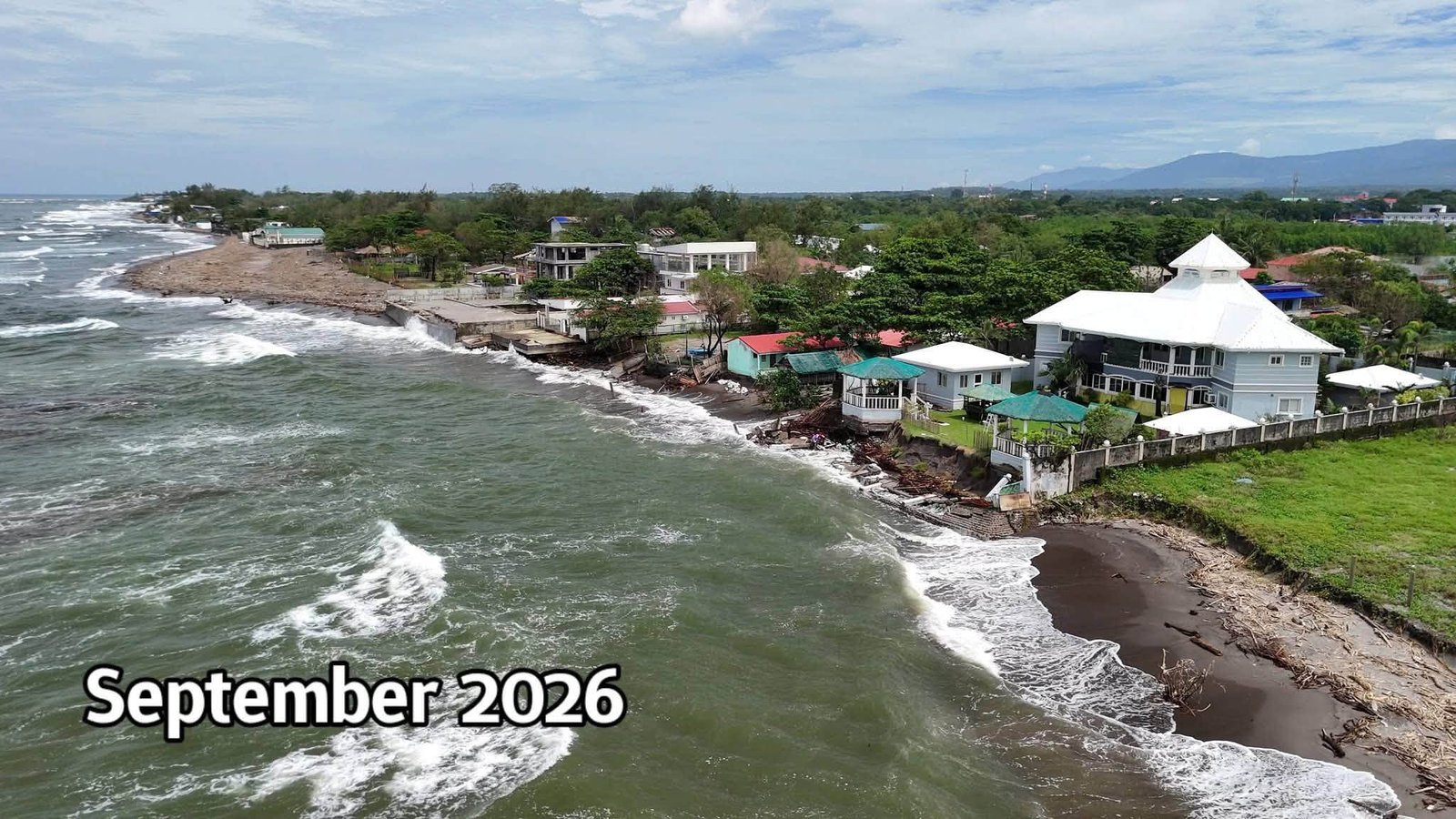
Photo courtesy of Randy Datu
SAN FELIPE, Zambales — The sea is steadily moving closer to the communities and businesses along the coast of San Felipe, raising concerns over the future of one of Zambales’ popular beach destinations.
In Liwliwa, residents and resort operators have watched portions of the beachfront shrink, with waves reaching areas that once had wider stretches of sand.
For some residents, the timing has raised a difficult question: Is dredging contributing to the erosion?
Several resort operators have blamed dredging activities in nearby waterways for disrupting the natural movement of sand and sediment toward the coast. Some have reported losing substantial portions of their beachfront, while others have seen structures damaged or swept away during strong wave events.
But government geologists say the story is more complicated.
The Mines and Geosciences Bureau (MGB) has said erosion in the area existed even before the current dredging activities. MGB officials point to the geological history of San Felipe, where enormous volumes of volcanic and river sediments from the 1991 Mount Pinatubo eruption substantially expanded portions of the coastline.
The resulting shoreline, they said, is naturally dynamic—gaining land in some periods and losing it during others as waves, storms and seasonal conditions redistribute sediment.
Still, dredging remains a legitimate issue for scientific investigation.
A 2025 study of the Maloma River dredging project found that dredging affected river flow, sediment movement and erosion-deposition processes, although the researchers noted limitations in available data and recommended more detailed hydrodynamic and sediment-transport studies.
This means the evidence does not yet establish that dredging directly caused the erosion at Liwliwa. But it also underscores why residents’ concerns deserve technical examination.
The key question is whether dredging has altered the natural sediment budget—the amount of material entering, moving through and replenishing the coastline—and whether that has accelerated erosion in already vulnerable areas.
For San Felipe, the answer could have major implications for tourism, fishing, property owners and future coastal development.
The shoreline is changing. The challenge now is to determine why—and how much human activity is influencing that change.