

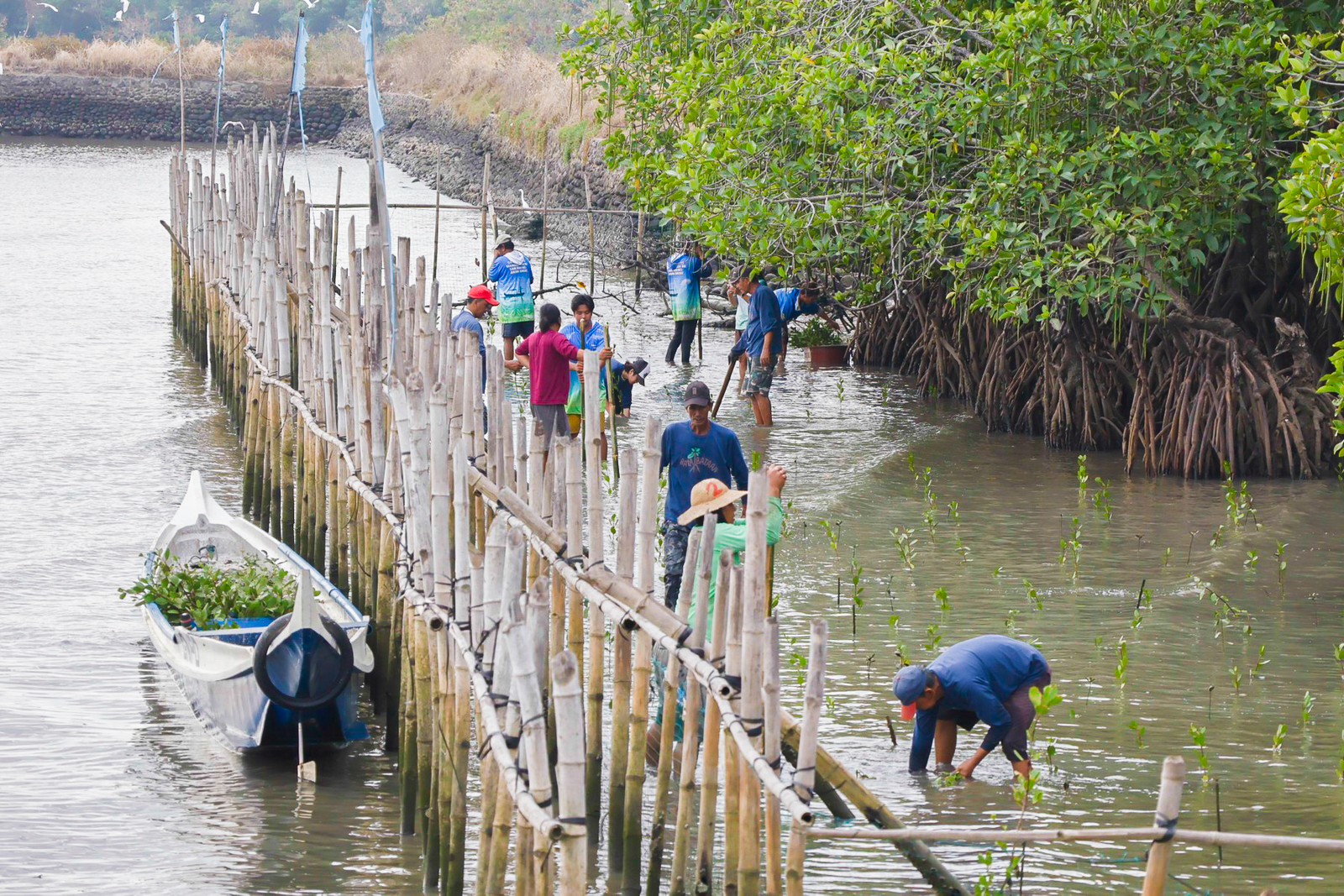
Enhancement planting. Volunteers from AboitizPower’s GNPower Mariveles Energy Center (GMEC) and GNPower Dinginin (GNPD), the Provincial Government of Bataan (PGB), the Provincial Government Environment and Natural Resources Office (PG-ENRO), and the local people’s organization in the area called Samahan ng Mangingisda ng San Rafael – Anak Dagat (SAMASAD), plant 2,300 mangrove saplings in the company’s adopted mangrove site in Samal, Bataan.
In Bataan, the public-private sectors and the people understand how energy can be harnessed as a powerful force for good.
While the power plants of Mariveles anchor the province’s industrial landscape, their influence extends far beyond the plants’ gates. Along the coasts of Morong and Orani, fishing communities feel the connection between energy and the environment through the health of the coasts. Here, the reality is clear: energy, environment, and livelihood are intertwined.
For residents, the impact is not measured in the kilowatt-hours that power their homes, but in what they see along their shorelines, in their daily catch, and in the long-term condition of the ecosystems they depend on.
For fisherfolk like Marcelindo Silvestre of the Tubo-Tubo Fisherfolks Association, these connections are felt in practical terms.
“This is a big help to us,” he shared. “When the mangroves are healthy, fish, crabs, and shrimp return. Our catch improves. At the same time, they protect us from strong waves.”
Across parts of Orani and Samal, around 37 hectares of mangroves have been rehabilitated and maintained through partnerships involving local communities, government, and AboitizPower subsidiaries GNPower Mariveles Energy Center (GMEC) and GNPower Dinginin (GNPD). These areas now serve as both natural coastal barriers and breeding grounds for marine life—benefits that directly support livelihoods.
“We really feel that they (GMEC and GNPD) are true partners because they listen to us,” Silvestre said. “They ask, ‘What do you need? What is the situation at sea?’ Because of that, we don’t feel like mere beneficiaries—we feel like family looking out for one another. It’s fulfilling to work when you know your partners genuinely cares about your livelihood and isn’t just focused on business.”
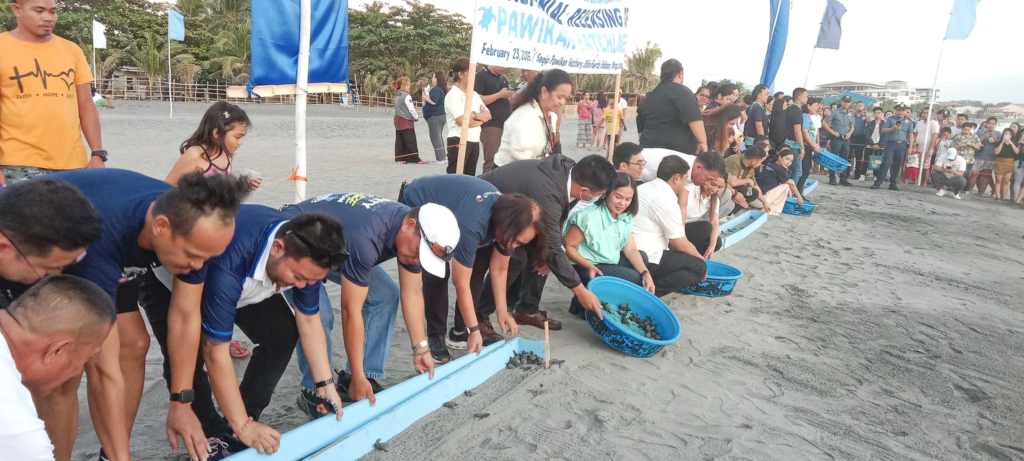
Sagip PaWeCan. A total of 336 sea turtle hatchlings were released to the Morong sea during a ceremonial release last February 2026.
Further along the shoreline in Sitio Fuerte, Morong, another effort is quietly taking place. Through the Sagip PaWeCan initiative, sea turtle eggs are relocated from vulnerable nesting areas to a protected hatchery, where conditions are managed to improve survival rates.
“SagiPaWeCan has made a lasting mark on Bataan’s environmental conservation efforts,” said Provincial Government Environment and Natural Resources Office (PGENRO) OIC Raphael De Leon. “It significantly contributed to the preservation of Bataan’s sea turtle population, strengthened the province’s eco-tourism potential, and educated local communities about environmental stewardship.”
Since 2023, the initiative has supported the release of thousands of hatchlings back into the sea, with local partners—including the PGENRO—playing a key role in sustaining the effort.
While these initiatives are modest compared to the scale of power generation, they reflect a broader shift in how operations are viewed within host communities—not only in terms of output, but in terms of presence and responsibility.
“It’s easy to see us only as a source of electricity,” Mendoza said. “But we view ourselves as part of the same local fabric. We share the same coastlines and the same future as these coastal villages. Our work isn’t finished by producing power, it continues in the health of the sea and the resilience of these fishing communities.”
As operators of baseload facilities, GMEC and GNPD continue to play a central role in supporting grid reliability. At the same time, efforts on the ground demonstrate that an integrated approach to operations, one that considers environmental stewardship and community partnership as part of day-to-day reality, is integral to long-term sustainability.
In Bataan, where industry and coastal life meet, that balance is not defined by a single project or outcome. It is shaped over time—through sustained engagement, shared accountability, and results that communities themselves can see, own, and sustain.