

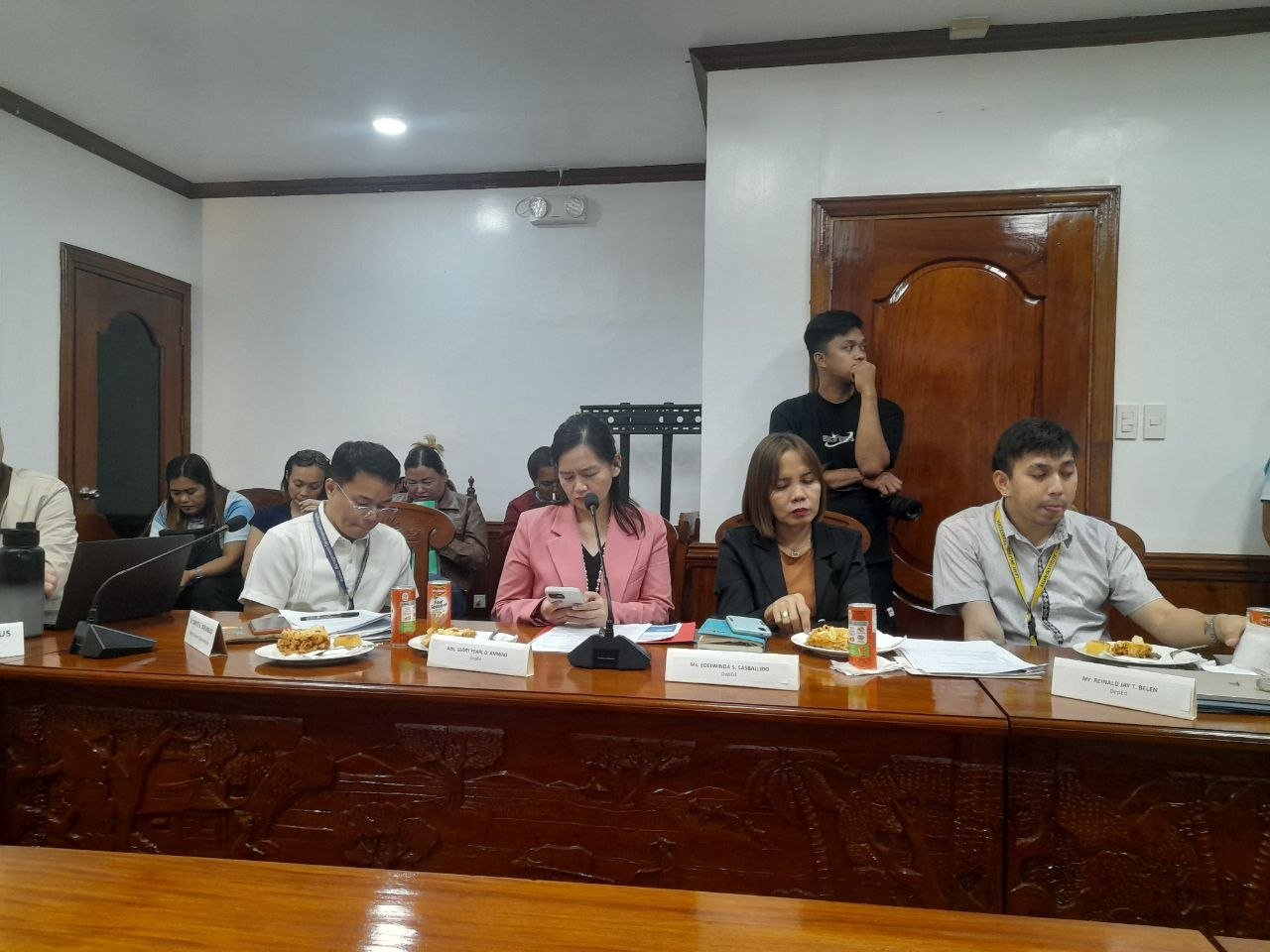
BALER, Aurora — Schools Division Superintendent Dr. Dante G. Parungao discusses Aurora’s school safety protocols and the Department of Education’s S.A.F.E. Program (Shield, Affirm, Fortify, Extend) during a press conference at the Governor’s Conference Hall, Provincial Capitol Building, Barangay Suklayin, Baler, Aurora, on Thursday, Aug. 13, 2026.
BALER, Aurora — The Department of Education (DepEd) Aurora is strengthening its child protection and school safety mechanisms through a comprehensive intervention program following the monitoring of 115 reported bullying incidents from School Year (SY) 2025–2026 to the first term of SY 2026–2027.
Schools Division Superintendent Dr. Dante G. Parungao presented Aurora’s school safety protocols on school violence and bullying during a press conference held Thursday, Aug. 13, 2026, at the Governor’s Conference Hall, Provincial Capitol Building, Barangay Suklayin, Baler, Aurora.
Parungao said DepEd Aurora’s Child Protection Program is anchored on Republic Act No. 10627, or the Anti-Bullying Act of 2013, and the current implementing rules and regulations under DepEd Memorandum No. 90, s. 2025.
He also cited DepEd Order No. 6, s. 2026, or the guidelines on ensuring a safe and motivating learning environment, which supplements the current anti-bullying framework and provides a localized policy template for schools.
DepEd Order No. 40, s. 2012, which originally contained the department’s Child Protection Policy and anti-bullying provisions, has been superseded in its anti-bullying provisions by the revised 2025 implementing rules, according to Parungao.
Physical, verbal bullying dominate reported cases
Data presented by Parungao showed that 115 bullying incidents were reported through the On-Time Monitoring of Bullying Cases covering SY 2025–2026 to the first term of SY 2026–2027.
Physical bullying accounted for the highest number at 56 cases, involving incidents such as fighting, punching, physical intimidation, extortion and assault.
Verbal bullying followed with 49 cases, including name-calling, threats, cursing and demanding money.
Five cases involved social or relational bullying, such as spreading rumors, exclusion and damaging peer relationships.
Three cases were classified as cyberbullying involving Facebook harassment, TikTok-related posts and group-chat shaming.
The monitoring also recorded one psychological or emotional bullying case involving repeated exclusion that caused distress and isolation, and one case of sexual bullying involving unwanted touching or grabbing without consent.
Physical and verbal bullying therefore accounted for 105 of the 115 reported cases, or more than 90 percent of the total.
SAFE Program provides four-tiered response
To address the problem, DepEd Aurora is implementing the S.A.F.E. Program, which stands for Shield, Affirm, Fortify and Extend, designed to strengthen learner protection and promote safer schools.
Under the Shield pillar, schools provide immediate protection and intervention for learners at risk or already affected by bullying and violence.
Measures include case protocols for adult-to-learner and learner-to-learner incidents, risk assessment, intake procedures, Psychological First Aid and counseling.
DepEd Aurora currently has five guidance counselors assigned to identified schools, while the division is hiring 31 School Guidance Associates and one Schools Division Counselor.
The division also has 10 certified Child Protection Specialists and is deploying Blue Guards, funded through the Special Education Fund (SEF), to high schools.
Other interventions include Batang Ligtas seminars and teacher training on child protection, gender sensitivity and case management.
Empowering students to become allies
The Affirm pillar focuses on developing a positive peer culture in which students are encouraged to look out for one another and intervene appropriately when bullying occurs.
Among the measures are the inclusion of learner representatives from the Supreme Secondary Learner Government (SSLG) in School Child Protection Committees, SSLG and SELG leadership training with anti-bullying components, peer support and mediation, bystander intervention training, values education, mentoring programs and student-led information campaigns.
DepEd Aurora also recognizes positive peer behavior and has 74 certified school-based career advocates supporting learner development.
Strengthening parent involvement
Under the Fortify pillar, DepEd aims to strengthen partnerships between schools and families.
Parents are represented in School Child Protection Committees and are provided annual orientations on child protection and anti-bullying policies.
Other initiatives include Parent Effectiveness Service sessions, positive discipline at home, home visitation, and parent-teacher-guidance conferences for specific cases.
Parungao emphasized that parents have an important role in monitoring their children’s experiences both in school and online.
Parents who encounter bullying or violence are encouraged to report directly to their school’s Child Protection Committee or Guidance Office, which serves as the primary reporting channel.
Expanding community partnerships
The Extend pillar connects schools with local communities, government agencies, and other stakeholders to provide sustained protection and referral services.
DepEd Aurora is strengthening referral pathways with the Philippine National Police Women and Children Protection Desk (PNP-WCPD) and Anti-Cybercrime Unit, the Department of Social Welfare and Development (DSWD), Department of Health (DOH), and other health and social service partners.
Community representatives, including Barangay Council for the Protection of Children (BCPC) links, are also involved in school-level child protection mechanisms.
The division also plans to strengthen partnerships with local government units, nongovernment organizations, civil society organizations, private sector groups and media organizations.
Standardized reporting and accountability
Parungao said the SAFE Program is supported by an institutional governance framework intended to ensure consistent reporting, accountability and data-driven decision-making.
DepEd Aurora is implementing a standardized incident classification and reporting template across schools, with quarterly case reporting from the School Child Protection Committee to the Division Child Protection Committee and the School Governance and Operations Division (SGOD).
The division also plans to integrate child protection initiatives into school and annual investment planning documents and mobilize resources through the SEF, Local School Board, Maintenance and Other Operating Expenses (MOOE), local ordinances and private partnerships.
An annual SAFE Program review will also be conducted.
Clear reporting pathway for parents and learners
Parungao urged parents and learners to report bullying and violence through established school-level mechanisms.
The first step is to report the incident to the School Child Protection Committee or Guidance Office, where intake, risk assessment and appropriate intervention are initiated.
Cases requiring higher-level intervention, or those not adequately addressed at the school level, may be elevated to the DepEd Aurora Schools Division Office.
The division office is located at Sitio Hiwalayan, Barangay Bacong, San Luis, Aurora, and may be reached through its official contact channels.
DepEd eyes deeper prevention and stronger monitoring
Looking ahead, DepEd Aurora plans to deepen the SAFE Program through targeted and preventive interventions.
Among the priorities are deploying additional Blue Guards to public schools, hiring more School Guidance Associates, expanding peer support and mediation programs, incorporating anti-bullying modules into learner leadership training, and piloting bystander intervention programs.
The division also plans to expand parent orientations, home visitation for at-risk learners, positive discipline sessions, and community-level monitoring.
Parungao said DepEd Aurora will also work toward a stronger data and monitoring system by using standardized reporting templates aligned with DepEd Memorandum No. 90, s. 2025, conducting quarterly data validation with School Child Protection Committees, and strengthening safeguards for sensitive learner records.
The division emphasized that addressing bullying and school violence requires sustained cooperation among schools, parents, learners, local governments, law enforcement agencies, health and social welfare institutions, and communities.
“A child who feels safe today becomes the leader Aurora needs tomorrow,” the presentation underscored, reflecting DepEd Aurora’s goal of making learner protection a shared responsibility and ensuring that every school provides a safe, supportive and motivating environment for children. (Jason de Asis)